Kindred: a privacy-first AI product for schools
Compliant learning plans, drafted from the reports schools already hold, without a word of student data reaching the model.
AI product · data protection · education · live
The problem
Australian schools have to write Personalised Learning Plans for students with additional needs, in a specific compliant format, and they have to do it on top of everything else. The information needed is already sitting in clinical reports from psychologists, OTs and speech pathologists, but pulling it into a plan is slow, and those reports are some of the most sensitive documents a school holds.
The hard part was never the writing. It was doing it without exposing student data, in each school’s own template, in a way a teacher trusts and stays in control of.
What I built
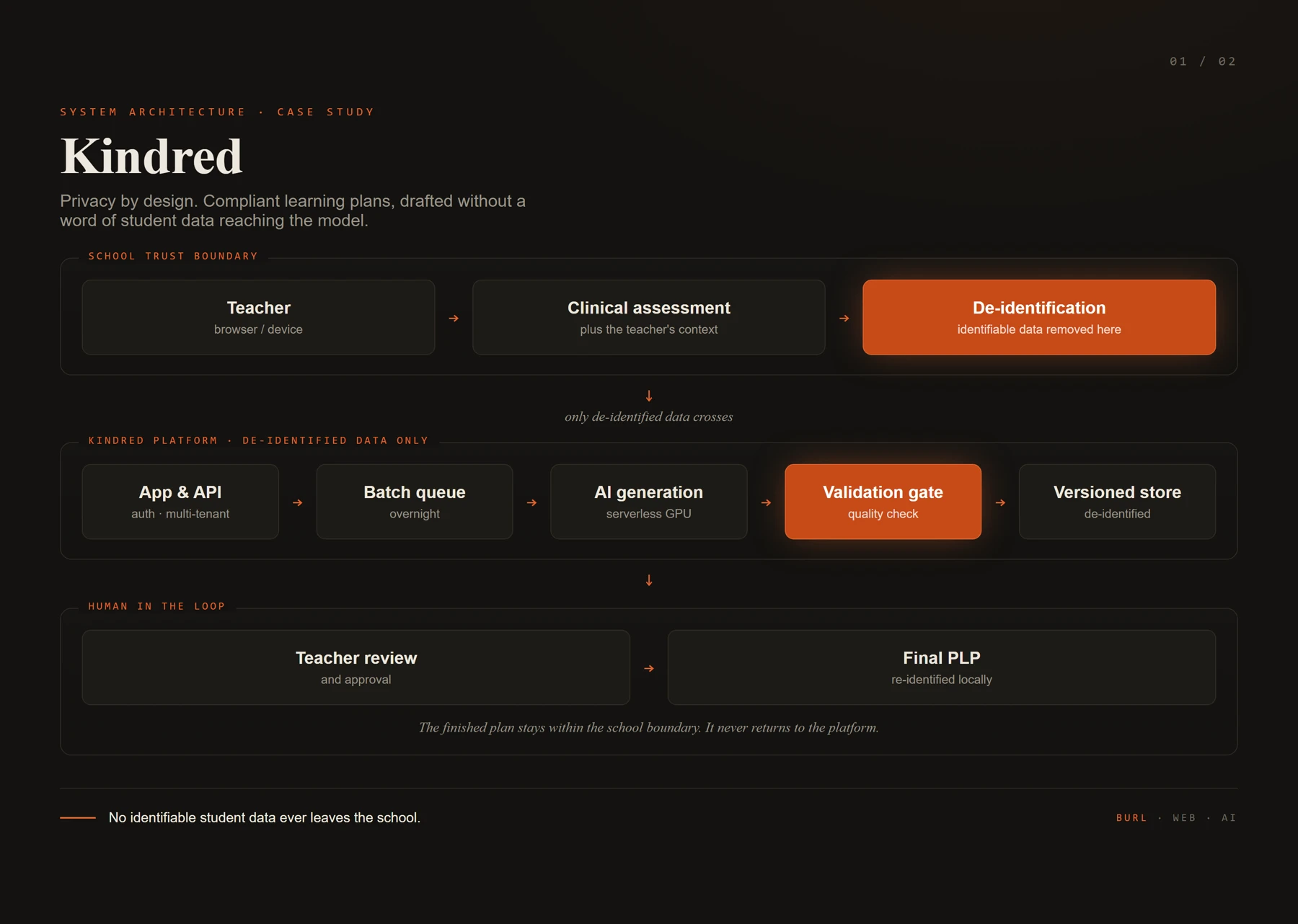
Kindred takes the clinical PDFs a family already has on file, plus the twenty minutes of context only the teacher has, and drafts a compliant plan in the school’s own layout and language. The teacher edits the draft in place and exports a parent-ready document. It is live at app.kindredschools.net, with a separate marketing site driving enquiries.
The part that matters: privacy by design
Student information is de-identified in two stages before generation. An edge pass strips names, dates of birth, addresses, phone numbers and IDs and replaces them with placeholders. Then a second pass runs through an isolated medical-NER service with no internet access, which catches residual identifiers and fails closed, so nothing personal reaches the model. There is a full data-protection impact assessment in the repo, an audit log of every run, an OCR fallback for scanned reports, and a production runbook. The privacy spine is the product, not a feature bolted on.
What it demonstrates
Shipping a real, privacy-critical AI product end to end, with an architecture you can defend to a data-protection officer. It is Dockerised, deployed, and running, not a prototype. The same de-identification core was later reused, deliberately at arm’s length, to power a second product (Assessor), which is the payoff of building the privacy layer properly the first time.
What I would bring to your project
If you are putting an AI feature near sensitive data, I know how to keep the data away from the model, prove it, and still ship something people want to use. Privacy and usefulness are not a trade-off if the architecture is right.