AI that does a real job, and admits when it can't.
For founders and businesses that need something built properly: an AI feature, a product, a migration, an integration.
Analysis first.
Most projects don't fail in the build. They fail because the wrong thing got built.
So before we write code, we work out what should be built, and how we'll know it worked. Who else is doing this. Where you're actually different. The one constraint that should drive the design. What being wrong will cost.
Then we build it.
What that looks like.
AI near sensitive data.
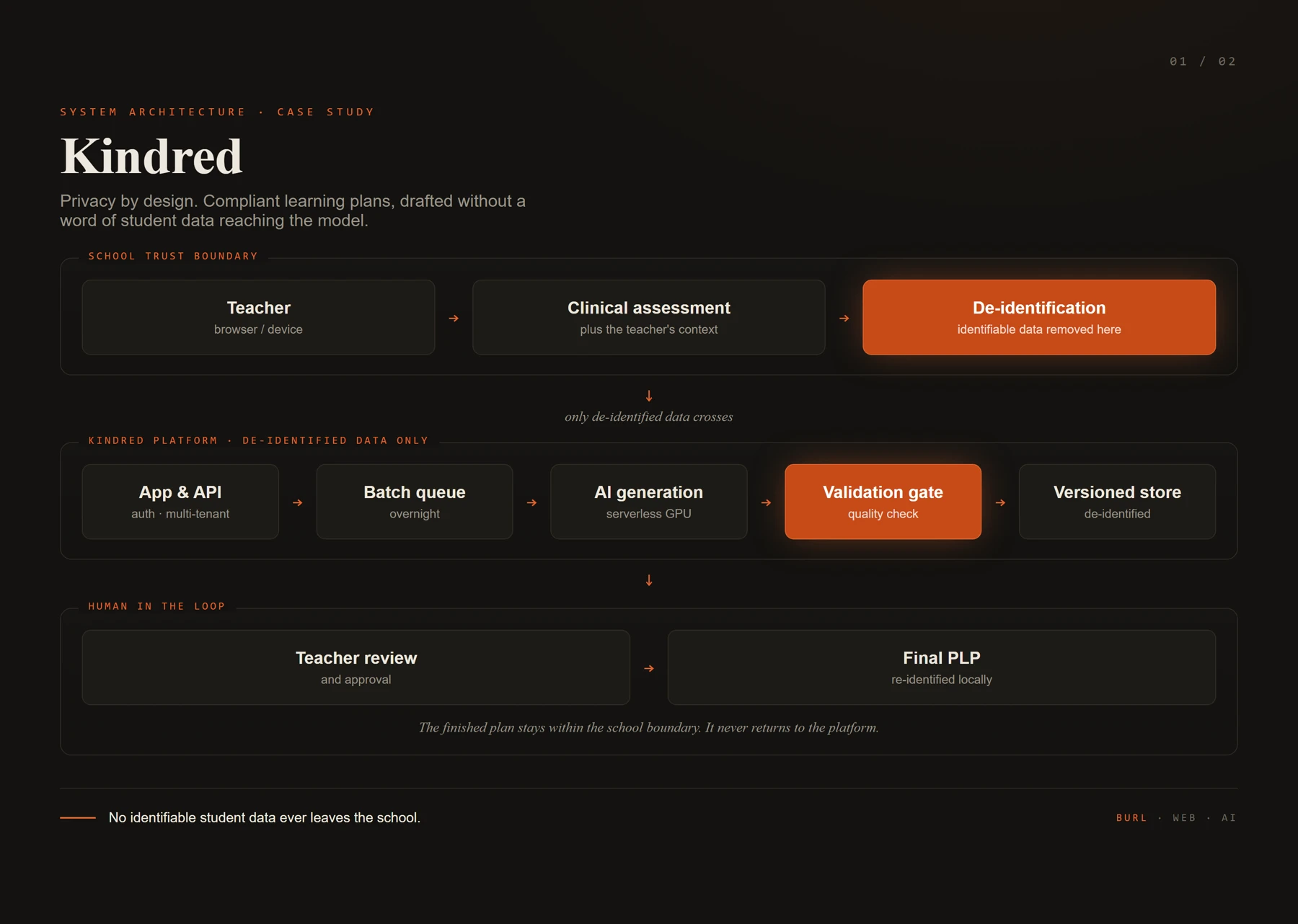
On Kindred, a separate de-identification step runs before anything reaches the model. If it can't run, the whole request stops. It does not fall back to sending the real data.
51% → 87%
$12.83 → $1.37
Pipelines engineered for cost.
On the construction engine we ran seven engines against the same 934 crops of drawings. The winner caught more (51% to 87% on printed values) and cost less ($12.83 to $1.37 a pack).

Honest output.
Assessor scores each criterion as marked, not demonstrated, or not assessable. It never guesses a mark to fill a cell.
"Tool couldn't mark this. You mark it."
Legacy data, reverse-engineered.
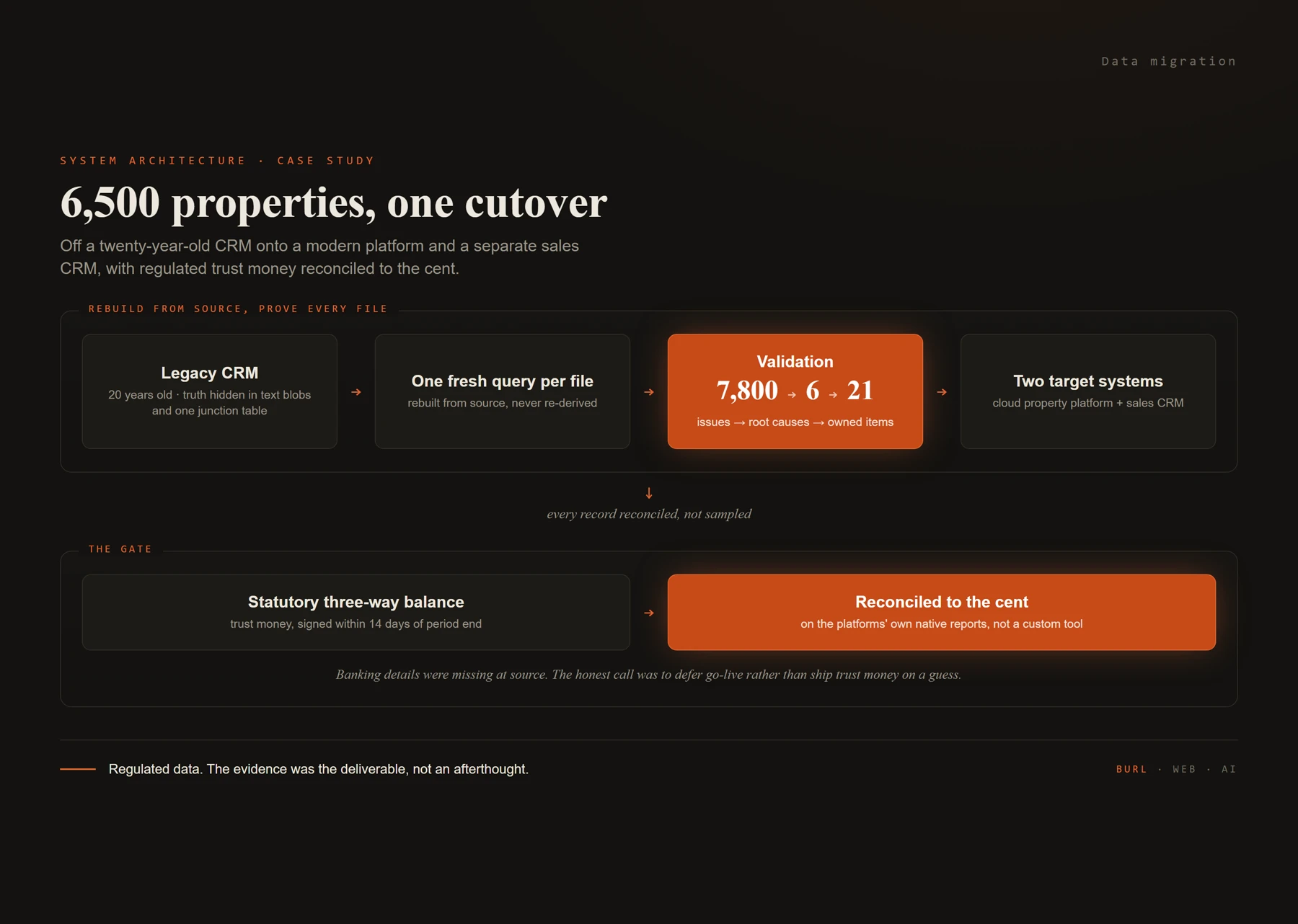
In a senior role before Burl, Sam mapped an undocumented twenty-year-old property system, about 6,500 properties, and turned 7,800 raw data issues into six root causes and 21 owned items. When the banking details for owner payments turned out not to exist in the source at all, he recommended delaying go-live rather than shipping a guess.
7,800 → 6 → 21
Proof of done.
Done means measured, not "it looks right."
On the construction engine there is more test code than product code. On the livestream overlay every requirement traces from the brief, to the code, to the evidence it works, and that matrix was handed over with the build. We send updates you can check yourself, not reports you take on trust.
Regulated or personal data.
If it touches health, financial or children's information, the code is half the job. For Kindred that meant a privacy impact assessment template a school's privacy officer can complete, a responsible AI framework, an LLM risk mapping and an incident plan. Data kept in Australia.
When we're not the right fit.
If you have a well-specified ticket queue and know exactly what you want, you can get it done cheaper elsewhere. We earn our keep where the hard part is working out what to build, or where being wrong is expensive.
Bring us the idea before you fund it.
We'll pressure-test it first.